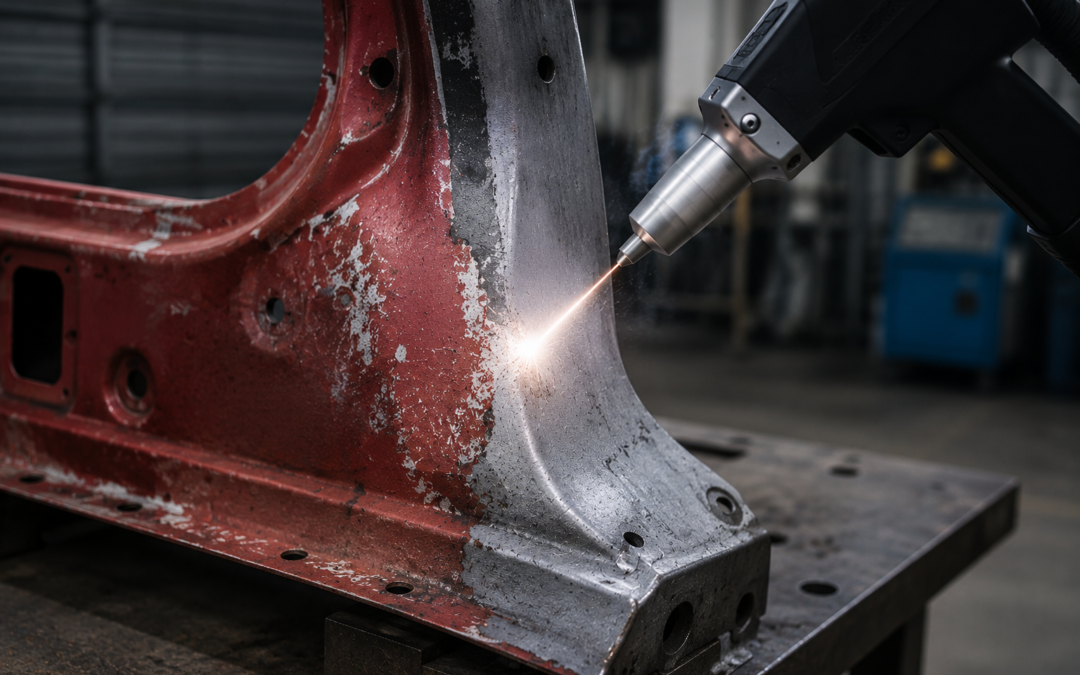
Paint removal is one of the most common industrial applications for laser cleaning technology. Traditional paint stripping methods often involve grinding, chemicals or abrasive blasting, which can damage the underlying material and create large amounts of waste.
Laser cleaning provides a cleaner and more precise alternative for removing paint from metal surfaces while helping preserve the original material underneath.
How Laser Paint Removal Works
Laser cleaning uses concentrated laser energy to target and remove surface coatings such as paint, oxidation and contamination.
The coating absorbs the laser energy and separates from the surface, while the metal underneath remains largely unaffected when the correct settings are used.
Because the process is highly controlled, operators can adjust:
- laser intensity
- cleaning speed
- pulse settings
- treatment area
depending on the material and coating type.
Advantages Over Traditional Paint Stripping
Traditional paint removal methods may:
- create excessive dust
- damage sensitive surfaces
- require aggressive chemicals
- increase cleanup time
- remove base material
Laser cleaning reduces many of these issues by offering:
- non-abrasive cleaning
- high precision
- minimal waste
- reduced cleanup
- no harsh chemicals
This makes it increasingly popular across industrial and restoration sectors.
Common Applications
Laser paint removal can be used for:
- machinery restoration
- automotive restoration
- industrial equipment
- weld preparation
- surface preparation before recoating
- metal component cleaning
It is especially useful where preserving the original surface is important.
Is Laser Cleaning Suitable For All Paint Types?
Different coatings respond differently depending on:
- thickness
- composition
- age
- adhesion
- surface material
Some coatings may require:
- slower cleaning speeds
- multiple passes
- test patches
This is why professional assessment is important before starting larger projects.
Industrial & Automotive Uses
In industrial environments, paint removal is often necessary before:
- repairs
- welding
- refinishing
- inspections
- maintenance work
In automotive restoration, laser cleaning may help remove old coatings while preserving valuable components and reducing excessive abrasion.
Cleaner Working Environment
One of the biggest advantages of laser paint removal is reduced mess compared to traditional abrasive methods.
Because there is no blasting media involved, laser cleaning typically creates:
- less dust
- less secondary waste
- easier cleanup
- more controlled work areas
This can improve efficiency during maintenance and restoration projects.
Final Thoughts
Laser cleaning offers a modern and highly precise solution for paint removal across industrial, automotive and restoration applications.
Its non-abrasive process, reduced cleanup requirements and ability to preserve the underlying surface make it an increasingly attractive alternative to traditional paint stripping methods.