Laser Wood Stripping vs Sanding: Which Method Is Better?
When restoring wooden furniture, exposed beams or other timber surfaces, choosing the right method for removing old paint, varnish or surface coatings can make a considerable difference to the final result.
Traditional sanding is one of the most widely used wood restoration methods. However, laser cleaning is becoming another option for removing certain coatings and surface contaminants without relying on abrasive contact.
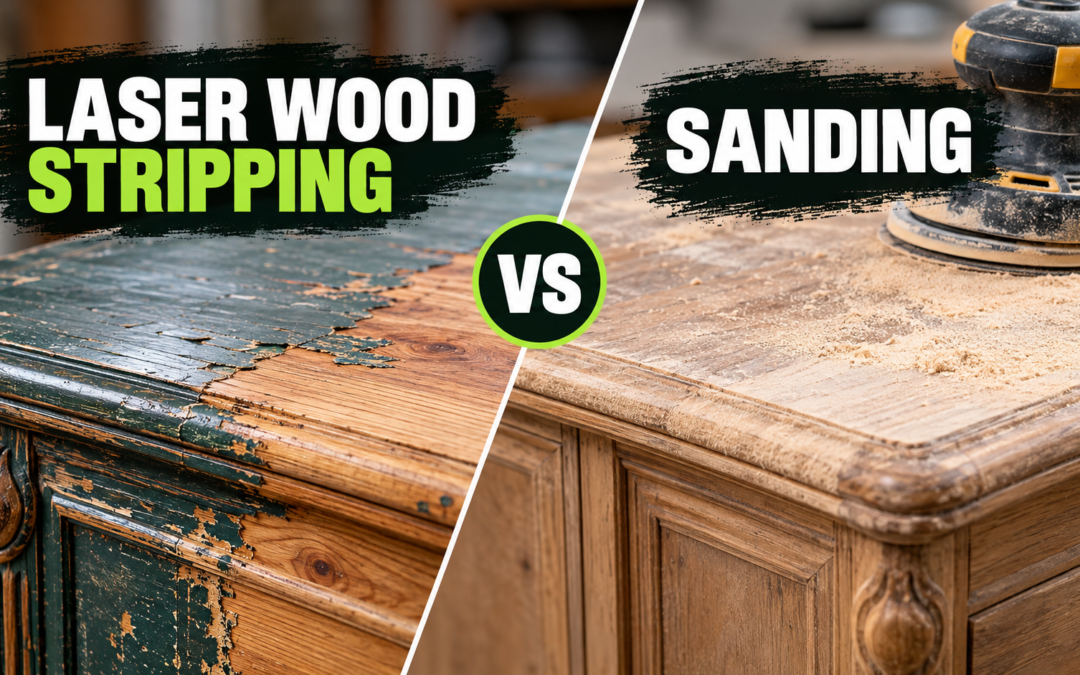
So, laser wood stripping vs sanding: which method is better?
The answer depends on the type of wood, the coating being removed, the condition of the surface and the finish you want to achieve.
Both methods have advantages, but they work in very different ways.
How Does Each Method Work?
Laser Wood Stripping
Laser wood stripping uses controlled pulses of laser energy directed at the surface of the timber.
When the laser interacts with a suitable coating or contaminant, the absorbed energy can break down or remove the unwanted material. The aim is to remove the surface layer while limiting the effect on the underlying wood.
Unlike sanding, laser cleaning does not require abrasive tools to make physical contact with the surface.
This can be particularly useful when working with carved details, decorative features or areas that are difficult to reach using conventional sanding equipment.
However, wood is sensitive to heat, and laser cleaning is not suitable for every timber surface or coating. Incorrect settings can cause scorching, discolouration or damage to the wood fibres.
A small test area is essential before carrying out a larger wood restoration project.
Traditional Sanding
Sanding removes material through abrasion using sandpaper, sanding blocks or powered sanding equipment.
It is commonly used to remove old finishes, smooth uneven surfaces and prepare timber for painting, staining or varnishing.
Different grades of abrasive paper allow the operator to control how aggressively the surface is treated.
Sanding is particularly effective when the objective is to smooth the wood itself, rather than simply remove an existing coating.
However, because sanding physically removes material, repeated or aggressive treatment can alter the shape of edges, decorative details and delicate timber surfaces.
Surface Finish and Material Removal
One of the main differences between laser cleaning and sanding is how each method affects the underlying timber.
Preserving Wooden Details
Laser cleaning can offer advantages when removing suitable coatings from wooden surfaces with intricate details.
Because the process does not rely on mechanical abrasion, it may be possible to treat certain grooves, carved features and uneven surfaces without the same physical wear associated with sanding.
This makes laser cleaning worth considering for selected furniture restoration projects, decorative timber and exposed wooden beams.
However, laser cleaning does not automatically preserve every surface. Its suitability depends on the timber species, coating thickness, moisture content and laser parameters.
Creating a Smooth Finish
Sanding generally has the advantage when a smooth, uniform finish is required.
It can remove raised wood fibres, level small imperfections and prepare timber for a new protective coating.
Laser cleaning is primarily a coating and contaminant removal process. It does not replace sanding when the surface needs physical levelling.
In some restoration projects, the two methods can complement each other.
For example, laser cleaning may be used to remove a suitable old coating, followed by light sanding to prepare the timber for refinishing.
Dust, Safety and Preparation
Both methods require appropriate safety precautions, although the hazards are different.
Dust Produced by Sanding
Traditional sanding generates airborne wood dust and particles from the coating being removed.
Depending on the material, these particles may present respiratory hazards and require suitable dust extraction, respiratory protection and cleaning procedures.
Older painted surfaces can present additional risks, particularly where the coating composition is unknown.
Fumes and Particles from Laser Cleaning
Laser cleaning does not generate abrasive sanding dust in the same way, but it is not a dust-free or emission-free process.
Removing coatings with a laser can produce fumes, fine particles and potentially hazardous decomposition products.
Suitable extraction, ventilation and protective equipment are therefore necessary.
Professional laser cleaning also requires strict controls for laser radiation, including appropriate eye protection, restricted access to the working area and measures to protect people from direct or reflected exposure.
At PUREBEAM LASER CLEANING, work is assessed before treatment to determine the appropriate cleaning approach and site arrangements.
Surface Preparation
Both methods require preparation.
For sanding, this may involve protecting surrounding areas, selecting suitable abrasives and arranging dust extraction.
For laser cleaning, preparation includes assessing the timber and coating, carrying out a test where appropriate, establishing a controlled working area and arranging suitable fume extraction.
Neither method should be used on an unknown or potentially hazardous coating without first considering the risks.
Cost and Working Time
When comparing laser wood stripping vs sanding, cost is often one of the main considerations.
However, there is no single method that is always cheaper or faster.
When Sanding May Be More Economical
For straightforward projects involving flat, accessible wooden surfaces, traditional sanding is often a practical and cost-effective option.
Equipment is widely available, and many smaller jobs can be completed using conventional tools.
If the timber also requires smoothing or levelling, sanding may complete several preparation tasks in one process.
When Laser Cleaning May Be Worth Considering
Laser cleaning may be useful for certain restoration projects involving decorative timber, awkward surface profiles or coatings that are difficult to remove mechanically.
Because the process is non-contact, it can reduce the need for abrasive treatment of suitable surfaces.
However, laser cleaning equipment is specialised, and the working time depends heavily on the coating, timber condition, surface area and required finish.
Thick or difficult coatings may require slower treatment or may not be suitable for laser removal.
What Affects the Overall Cost?
The cost of either method depends on several factors:
- Size and accessibility of the surface
- Type and condition of the timber
- Thickness and composition of the existing coating
- Complexity of decorative details
- Required level of coating removal
- Preparation, extraction and finishing requirements
For larger projects, an initial assessment or test can help establish whether laser cleaning is technically suitable and commercially worthwhile.
Which Method Is Right for Your Project?
The best choice depends on what you are trying to achieve.
Choose Sanding When:
- You need to smooth or level the timber.
- The surface is relatively flat and accessible.
- You are preparing bare wood for painting or varnishing.
- Mechanical material removal is acceptable.
- You are carrying out straightforward restoration work.
Consider Laser Wood Stripping When:
- You want to investigate a non-contact coating removal method.
- The surface contains carved or decorative details.
- Conventional sanding would be difficult or undesirable.
- You are restoring suitable wooden beams or furniture components.
- A preliminary test confirms that the coating can be removed without unacceptable damage.
Laser cleaning should not automatically be selected for valuable antiques, historic timber or delicate veneers. Original finishes may have conservation value, and some surfaces can be damaged by heat.
Where historic or particularly valuable objects are involved, advice from a qualified conservator may be appropriate before any coating removal.
Can Laser Cleaning and Sanding Be Used Together?
Yes. In some situations, combining the two methods may produce a better result.
Laser cleaning can be considered for removing selected coatings, while sanding can be used afterwards where the timber requires smoothing before refinishing.
The most suitable approach should be determined by the condition of the wood and the intended final finish.
Professional Wood Laser Cleaning in Southampton and Hampshire
If you are planning a furniture restoration project, restoring exposed wooden beams or removing old coatings from timber, professional laser cleaning may be worth considering.
PUREBEAM LASER CLEANING provides mobile laser cleaning services across Southampton, Hampshire and surrounding areas.
We assess each project individually to determine whether laser cleaning is appropriate for the material, coating and required result.
Our mobile service allows suitable cleaning work to be carried out at the customer’s premises, subject to access, electrical supply, ventilation and safety requirements.
Request a Free Quote
Considering laser cleaning for your next wood restoration project?
Send us a few photographs of the wooden surface, along with its approximate dimensions, location and details of the coating you would like removed.
We can review the information and discuss whether laser cleaning may be suitable.
Contact PUREBEAM LASER CLEANING for a free, no-obligation quote.
Website: https://purebeamlasercleaning.co.uk