
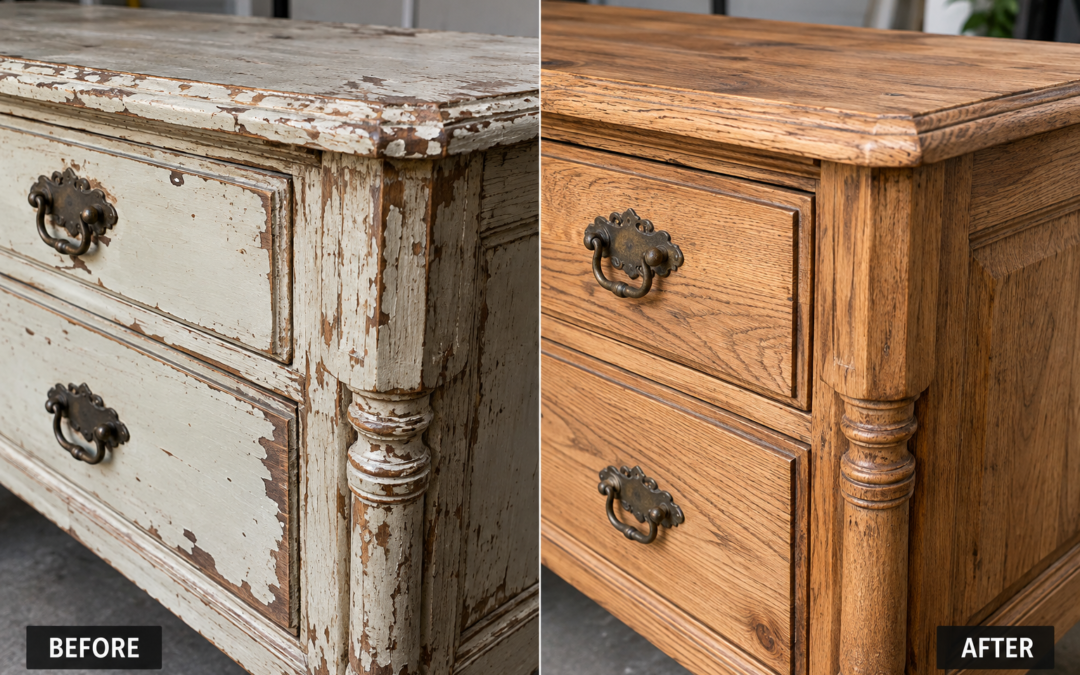
Removing old paint from wooden furniture can be a time-consuming process, particularly when dealing with multiple layers of paint, decorative details or surfaces that are difficult to sand.
Traditional methods such as sanding and chemical paint stripping can be effective, but they are not always suitable for every restoration project.
Laser cleaning offers another approach to removing paint from wood. Using controlled laser energy, it can remove certain coatings without the need for abrasive blasting media or chemical paint strippers.
But can laser cleaning remove paint from all wooden furniture, and how does it compare with traditional methods?
The answer depends on the type of wood, the existing coating and the condition of the furniture.
How Does Laser Paint Removal Work on Wood?
Laser cleaning works by directing short pulses of laser energy onto a coated surface. When the coating absorbs sufficient energy, it can break down and be removed from the underlying material.
This process is commonly referred to as laser ablation.
Unlike sanding, which mechanically removes material through abrasion, laser cleaning uses controlled energy to target surface layers.
For wooden furniture, this can be useful when removing certain paints, varnishes and other surface coatings.
However, wood requires particular care.
Wood is an organic, heat-sensitive material, and its response to laser cleaning can vary considerably depending on the species, moisture content, surface condition and coating.
The laser settings must therefore be selected carefully to minimise unwanted effects on the underlying timber.
One advantage of laser wood stripping is the ability to work on selected areas and detailed surfaces where conventional sanding may be difficult.
This does not mean that laser cleaning is completely risk-free or that the original wood will always remain unchanged.
Which Types of Wooden Furniture Can Be Treated?
Laser cleaning may be suitable for a range of wooden furniture restoration projects, provided the material and coating respond appropriately during testing.
Examples include:
- Wooden tables: Removing selected paint or varnish coatings from solid timber surfaces.
- Chairs: Cleaning painted wooden components, including certain shaped or decorative sections.
- Cabinets and cupboards: Removing existing coatings before refinishing.
- Wooden doors and panels: Stripping suitable coatings from larger timber surfaces.
- Decorative wooden furniture: Working on carved or shaped areas that can be difficult to access with conventional sanding equipment.
Solid wood is generally a more practical candidate for initial assessment than thin veneers or delicate composite materials.
However, suitability cannot be determined by appearance alone.
Some furniture contains different materials, adhesives, fillers or previous repairs that may react differently to laser exposure.
For this reason, the construction of the furniture should be considered before cleaning begins.
What About Painted or Varnished Furniture?
Not all coatings respond to laser cleaning in the same way.
Different paints and varnishes absorb laser energy differently. Their thickness, composition and age can affect how efficiently they can be removed.
Some coatings may come away relatively easily, while others require slower processing or may not be suitable for laser removal.
Where multiple layers are present, testing is particularly important.
Can Laser Cleaning Damage the Wood?
Yes. Laser cleaning can damage wood if inappropriate settings are used or the material is unsuitable for the process.
Although laser cleaning can offer precise control, wood is sensitive to heat.
Excessive energy or repeated exposure may cause:
- Darkening or discolouration of the surface.
- Scorching or charring.
- Changes to the natural texture of the timber.
- Unwanted removal of surface fibres.
- Damage to delicate details or existing finishes.
The risk depends on several factors, including the wood species, coating characteristics, laser parameters and the condition of the surface.
A controlled test on a small, inconspicuous area is the most reliable way to assess how a particular piece of furniture responds.
It is also important to understand that removing paint does not necessarily restore the wood to its original appearance.
Older furniture may have stains, previous sanding marks, repairs or discolouration hidden beneath the coating.
These imperfections can become visible once the paint has been removed.
Is Laser Cleaning Suitable for Antique Furniture?
Antique furniture requires additional consideration.
Original finishes, historical coatings and surface patina may contribute to the value and character of a piece.
Removing these layers without a proper assessment could cause irreversible changes.
For valuable or historically important furniture, advice from a qualified furniture conservator should be obtained before any stripping method is considered.
Laser Paint Removal vs Traditional Stripping
There are several ways to remove paint from wooden furniture, and each method has advantages and limitations.
The most appropriate choice depends on the furniture, coating and desired finish.
Laser Cleaning
Laser cleaning removes suitable coatings using controlled laser energy.
Potential advantages:
- No abrasive blasting media required.
- No chemical paint stripper applied to the surface.
- Precise treatment of selected areas.
- Potential access to shaped or decorative surfaces.
- Reduced mechanical contact compared with sanding.
Limitations:
- Not every paint or varnish is suitable.
- Incorrect settings can scorch or damage timber.
- Removal speed varies according to the coating.
- Specialist equipment and safety controls are required.
- Testing is necessary before treating unfamiliar surfaces.
Laser cleaning also produces airborne contaminants when coatings are removed. Appropriate extraction, ventilation and protective measures are required.
Sanding
Sanding is one of the most widely used methods for preparing wooden furniture.
It can be effective for removing surface coatings, smoothing timber and preparing wood for a new finish.
However, sanding also removes some of the underlying wood.
This can be a disadvantage when working with intricate carvings, sharp decorative edges or thin veneers.
Sanding also generates dust, which requires suitable extraction and respiratory protection.
Chemical Paint Stripping
Chemical stripping products soften or dissolve certain coatings so they can be removed from the surface.
They can be useful for complex shapes and multiple paint layers.
However, their effectiveness depends on the product and coating.
Chemical strippers may require additional cleaning, controlled handling and appropriate waste disposal.
Some products can also affect adhesives, finishes or sensitive materials.
Which Method Is Better?
There is no single method that is best for every wooden furniture restoration project.
Laser cleaning may be worth considering when precise coating removal is required or when conventional sanding presents practical difficulties.
Sanding may be more appropriate when the timber also needs reshaping or surface levelling.
Chemical stripping may be effective for coatings that respond poorly to other methods.
In some projects, a combination of techniques produces the most suitable result.
When Should You Request a Test?
A test is recommended whenever laser cleaning is being considered for painted or varnished wooden furniture.
This is particularly important when:
- The wood species is unknown.
- The furniture has several layers of paint.
- The coating is unusually thick or difficult to identify.
- The surface contains carvings or delicate details.
- The furniture has previously been repaired or refinished.
- The appearance of the exposed timber is particularly important.
A test area helps establish whether the coating can be removed effectively and whether the resulting surface meets the customer’s expectations.
It can also help estimate the time required for a larger restoration project.
What Should You Consider Before Booking?
Before arranging professional laser paint removal, it is useful to provide a few details about the furniture.
Photographs of the complete item and close-up images of the painted surface are a good starting point.
Approximate dimensions, the type of wood (if known) and any information about previous coatings can also help with the initial assessment.
For older painted furniture, the possibility of lead-based paint or other hazardous coatings should be considered. Where such materials are suspected, appropriate identification and safety arrangements are necessary before removal work begins.
Professional Laser Wood Stripping in Southampton and Hampshire
PUREBEAM LASER CLEANING provides mobile laser cleaning services across Southampton, Hampshire and surrounding areas.
Our services include surface cleaning and coating removal for suitable materials, including selected wood restoration projects.
We assess each project individually because the effectiveness of laser cleaning depends on the material, coating and required finish.
Whether you are restoring wooden furniture, removing old paint from timber or preparing a suitable wooden surface for refinishing, we can discuss your project and assess whether laser cleaning is an appropriate option.
Request a Free Quote
Have a piece of wooden furniture that needs paint or varnish removal?
Send PUREBEAM LASER CLEANING a few photographs of the item, along with its approximate dimensions and location.
We can review the information, discuss the available options and advise whether an initial test may be required.
Contact PUREBEAM LASER CLEANING to request a free, no-obligation quote.
Website: https://purebeamlasercleaning.co.uk