Many businesses considering laser cleaning ask the same question: how long will the process take?
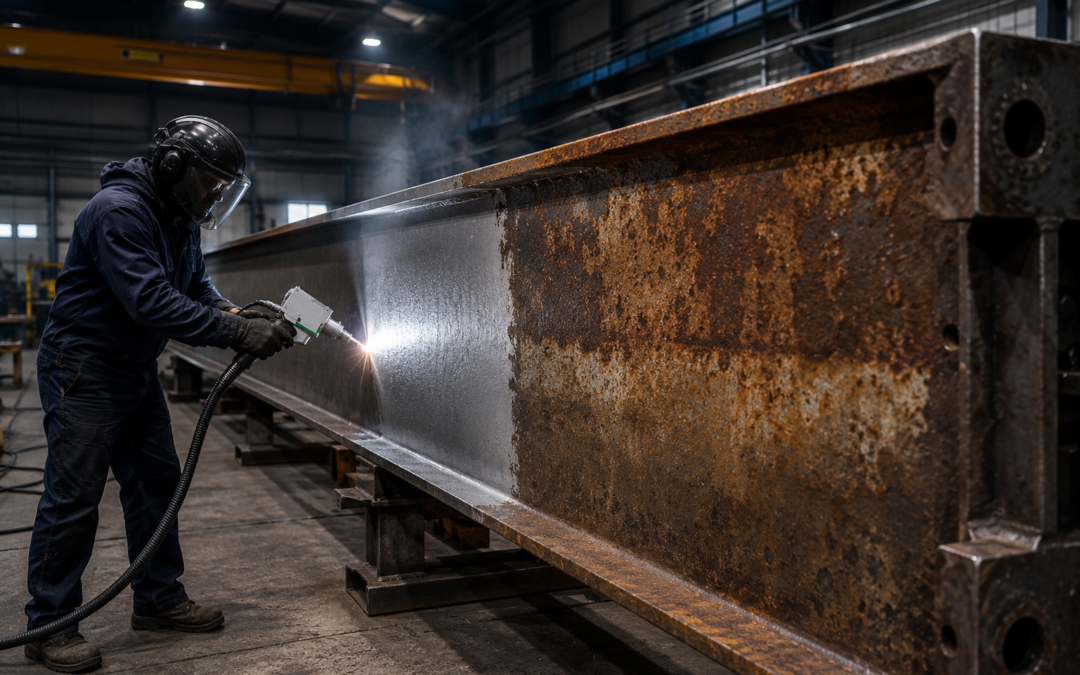
The answer depends on several factors, including the type of contamination, surface area, material condition, and the desired finish. While every project is unique, laser cleaning is often significantly faster than traditional cleaning methods, especially when preparation and cleanup time are considered.
What Affects Laser Cleaning Speed?
Several factors influence how quickly a surface can be cleaned.
Type Of Contamination
Different contaminants require different amounts of energy to remove.
For example:
• Light oxidation is typically removed very quickly
• Surface rust is usually straightforward to clean
• Thick paint coatings require more time
• Heavy corrosion may need multiple passes
• Carbon deposits vary depending on thickness
Surface Area
Naturally, larger surfaces take longer to clean than smaller components.
A small automotive part may take only minutes, while large industrial equipment could require several hours.
Surface Complexity
Flat surfaces are generally faster to clean than detailed or intricate components.
Complex parts may contain:
• Corners
• Grooves
• Threads
• Welds
• Decorative details
These areas require more careful treatment.
Desired Finish
Some customers simply want contamination removed, while others require a highly refined finish for restoration or preparation purposes.
Higher precision cleaning often takes additional time.
Typical Laser Cleaning Times
Although every project differs, the following examples provide a general idea.
Small Automotive Components
• 10 to 30 minutes
Examples include brackets, mounts, tools, and restoration parts.
Vehicle Components
• 30 minutes to several hours
Depending on contamination levels and component size.
Industrial Machinery
• Several hours to one day
Larger equipment may require more extensive cleaning.
Graffiti Removal
• Varies significantly
The type of paint, substrate, and affected area determine the cleaning time.
Stone Restoration
• Several hours to multiple days
Historic restoration projects often prioritise preservation over speed.
Why Laser Cleaning Can Save Time Overall
Many people focus only on the actual cleaning process.
However, traditional methods often require additional time for:
• Surface masking
• Chemical application
• Drying periods
• Abrasive media cleanup
• Waste disposal
Laser cleaning frequently reduces or eliminates these stages.
As a result, total project time can be significantly reduced.
Does More Power Mean Faster Cleaning?
Generally, higher powered systems can remove contamination more quickly.
However, cleaning speed is not determined by power alone.
Other important factors include:
• Pulse characteristics
• Material type
• Contamination thickness
• Operator technique
• Surface requirements
The best results come from using the appropriate settings for each specific application.
Is Laser Cleaning Faster Than Sandblasting?
In some applications, yes.
In others, the advantage comes from reduced preparation and cleanup rather than raw cleaning speed.
Laser cleaning is particularly beneficial when:
• Precision is important
• Components cannot be removed easily
• Minimal waste is required
• Surface preservation is critical
Mobile Laser Cleaning Advantages
On site laser cleaning can further reduce project times.
Instead of transporting equipment to another facility, cleaning can be performed directly at the customer’s location.
This helps reduce:
• Transportation delays
• Equipment downtime
• Operational disruption
Conclusion
The time required for laser cleaning depends on contamination type, surface condition, project size, and desired results.
While no two projects are identical, laser cleaning often delivers faster overall project completion by reducing preparation work, eliminating chemicals, minimising cleanup, and allowing precise treatment directly where it is needed.