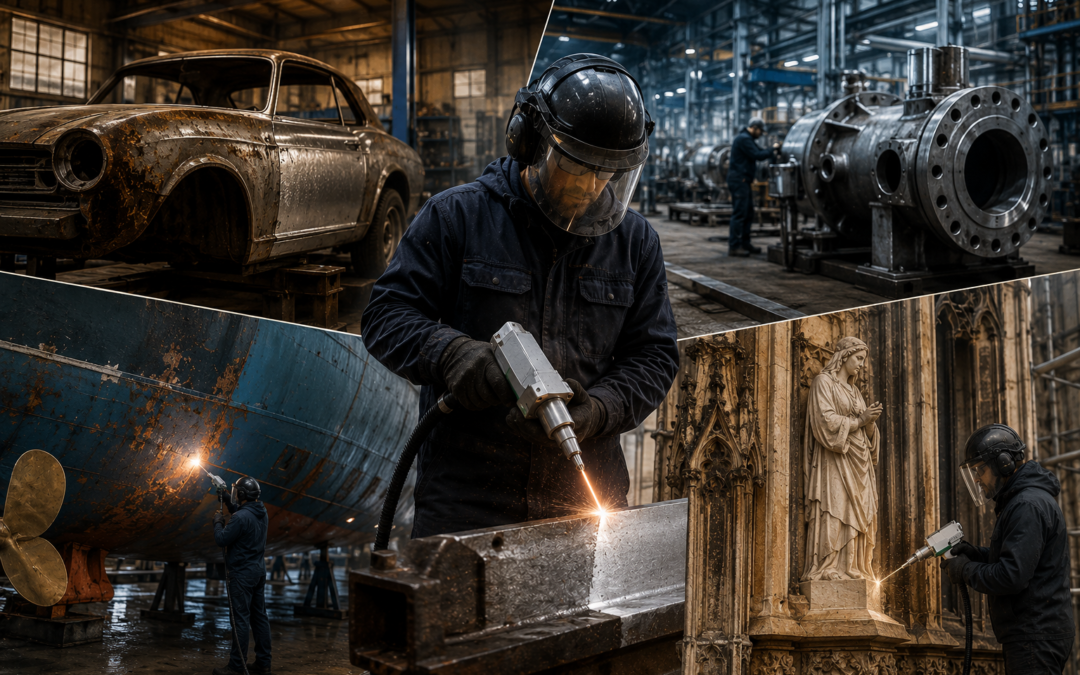
Laser cleaning technology is rapidly being adopted across a wide range of industries. Its ability to remove rust, paint, oxidation, grease, and contaminants without damaging the underlying surface makes it one of the most versatile cleaning solutions available today.
From manufacturing plants to restoration projects, businesses are increasingly turning to laser cleaning as an efficient and environmentally responsible alternative to traditional cleaning methods.
Why Industries Are Switching To Laser Cleaning
Many traditional cleaning methods involve abrasives, chemicals, or extensive manual labour.
Laser cleaning offers several advantages:
• Non abrasive surface treatment
• No chemicals required
• Minimal secondary waste
• Precision cleaning
• Reduced downtime
• Improved worker safety
These benefits make laser cleaning attractive across multiple sectors.
Manufacturing Industry
Manufacturing facilities regularly deal with contamination that can affect production quality.
Laser cleaning is commonly used for:
• Surface preparation before welding
• Removal of oxidation
• Cleaning production equipment
• Tool and mould maintenance
• Paint and coating removal
Because laser cleaning is highly precise, it helps maintain tight tolerances required in modern manufacturing.
Automotive Industry
The automotive sector has become one of the largest users of laser cleaning technology.
Applications include:
• Rust removal
• Paint stripping
• Engine component cleaning
• Chassis restoration
• Surface preparation
• Classic vehicle restoration
Unlike abrasive blasting, laser cleaning helps preserve valuable automotive components.
Aerospace Industry
Aerospace maintenance demands extreme precision.
Laser cleaning can be used for:
• Surface preparation
• Coating removal
• Component maintenance
• Oxidation removal
• Inspection preparation
The ability to clean sensitive parts without mechanical abrasion is particularly valuable in aerospace applications.
Marine Industry
Saltwater environments create significant corrosion challenges.
Laser cleaning is increasingly used for:
• Rust removal
• Corrosion treatment
• Ship maintenance
• Marine equipment restoration
• Surface preparation before coating
Reducing corrosion helps extend equipment lifespan and lower maintenance costs.
Construction And Structural Steel
Large steel structures often require ongoing maintenance.
Laser cleaning is suitable for:
• Structural steel cleaning
• Surface preparation before repainting
• Corrosion removal
• Equipment maintenance
• Infrastructure restoration
Its precision allows targeted treatment without affecting surrounding materials.
Heritage And Restoration Projects
Historic buildings, monuments, and architectural features often require specialist cleaning methods.
Laser cleaning is commonly used for:
• Stone restoration
• Monument cleaning
• Architectural preservation
• Graffiti removal
• Historic metal restoration
The non abrasive nature of laser cleaning helps preserve original materials and fine details.
Energy And Power Generation
Power stations and industrial energy facilities frequently use laser cleaning for maintenance operations.
Applications include:
• Turbine maintenance
• Surface preparation
• Corrosion removal
• Equipment cleaning
• Preventive maintenance
Reducing downtime is often a major benefit in these environments.
Engineering Workshops
Engineering companies use laser cleaning for both maintenance and restoration work.
Typical applications include:
• Machinery cleaning
• Component restoration
• Weld preparation
• Tool maintenance
• Rust removal
Mobile laser cleaning services make these applications accessible without transporting equipment off site.
Why Demand Continues To Grow
As businesses seek more sustainable and efficient maintenance solutions, laser cleaning continues to gain popularity.
The combination of precision, environmental benefits, and reduced downtime makes it attractive to organisations looking to improve operational efficiency while protecting valuable assets.
Conclusion
Laser cleaning is no longer limited to specialist applications. Today it is used across manufacturing, automotive, aerospace, marine, construction, restoration, energy, and engineering industries.
Its versatility and ability to clean surfaces without abrasive damage make it one of the most valuable modern maintenance technologies available.