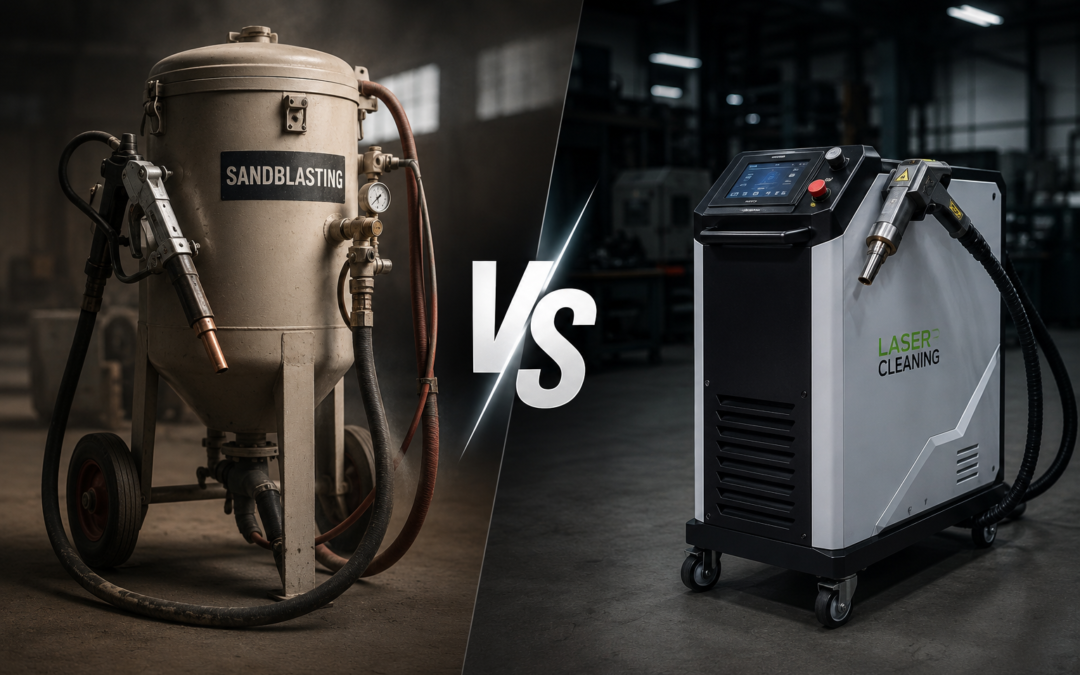
Metal restoration has traditionally relied on abrasive cleaning methods such as sandblasting, grinding and chemical treatments. While these methods can remove rust and contamination, they often create additional damage, dust, waste and surface wear.
Laser cleaning technology is changing the way industries approach restoration and maintenance by offering a cleaner, more precise and non-abrasive solution.
What Is Sandblasting?
Sandblasting uses abrasive particles propelled at high speed to strip rust, paint or contamination from a surface. It is widely used in industrial environments, automotive restoration and construction projects.
Although effective, sandblasting can:
- damage delicate surfaces
- create large amounts of dust
- remove base material
- require extensive cleanup
- generate hazardous waste
For sensitive components or restoration projects, this can become a major issue.
How Laser Cleaning Works
Laser cleaning uses concentrated laser pulses to remove unwanted material from the surface without physically grinding or blasting the metal underneath.
The laser targets rust, paint, oxidation or contamination while preserving the integrity of the original surface. This makes the process highly controlled and suitable for both industrial and delicate applications.
Key Advantages of Laser Cleaning
Non-Abrasive Process
Unlike sandblasting, laser cleaning does not physically wear down the surface. This helps preserve the original structure and finish of the material.
Minimal Waste
Laser cleaning produces significantly less waste compared to abrasive blasting methods. In many cases, only the removed contamination remains.
Reduced Cleanup
Because there is no blasting media involved, the work area stays much cleaner and easier to manage.
Greater Precision
Laser cleaning allows operators to focus on specific areas without affecting surrounding surfaces. This is especially useful for machinery, weld preparation and restoration work.
Environmentally Friendly
The process avoids aggressive chemicals and reduces airborne contaminants, making it a cleaner alternative for many industries.
Common Applications
Laser cleaning is becoming increasingly popular across multiple industries, including:
- automotive restoration
- industrial maintenance
- marine applications
- manufacturing equipment cleaning
- paint and coating removal
- weld preparation
- surface restoration
Its flexibility makes it suitable for both heavy industrial projects and more delicate restoration work.
Is Sandblasting Still Useful?
Sandblasting still has applications in certain large-scale projects where aggressive material removal is required. However, many businesses are now switching to laser cleaning for projects where surface preservation, precision and cleanliness are important.
The choice often depends on the type of material, contamination level and desired finish.
Final Thoughts
Laser cleaning is rapidly becoming one of the most advanced solutions for rust removal and surface restoration. Compared to traditional sandblasting, it offers a cleaner, more precise and less damaging process for a wide range of industrial applications.
As more industries move toward efficient and environmentally conscious solutions, laser cleaning continues to grow as a modern alternative for professional surface preparation and restoration.