Welding quality depends heavily on surface preparation. Even small amounts of rust, oxidation, oil, paint, or other contaminants can weaken a weld, reduce consistency, and create defects that lead to costly repairs. Laser cleaning offers a modern solution that prepares metal surfaces quickly, precisely, and without damaging the base material.
Why Surface Preparation Matters Before Welding
Before two metal components are welded together, the surface must be clean and free from contaminants. Any unwanted material between the welding arc and the base metal can affect penetration, weld strength, and overall quality.
Common contaminants include:
• Rust and corrosion
• Mill scale
• Paint and coatings
• Oil and grease
• Oxidation layers
• Dust and debris
Traditional cleaning methods often involve grinding, abrasive blasting, chemicals, or manual scraping. While effective in some situations, these methods can be time consuming and may alter the surface itself.
How Laser Cleaning Works
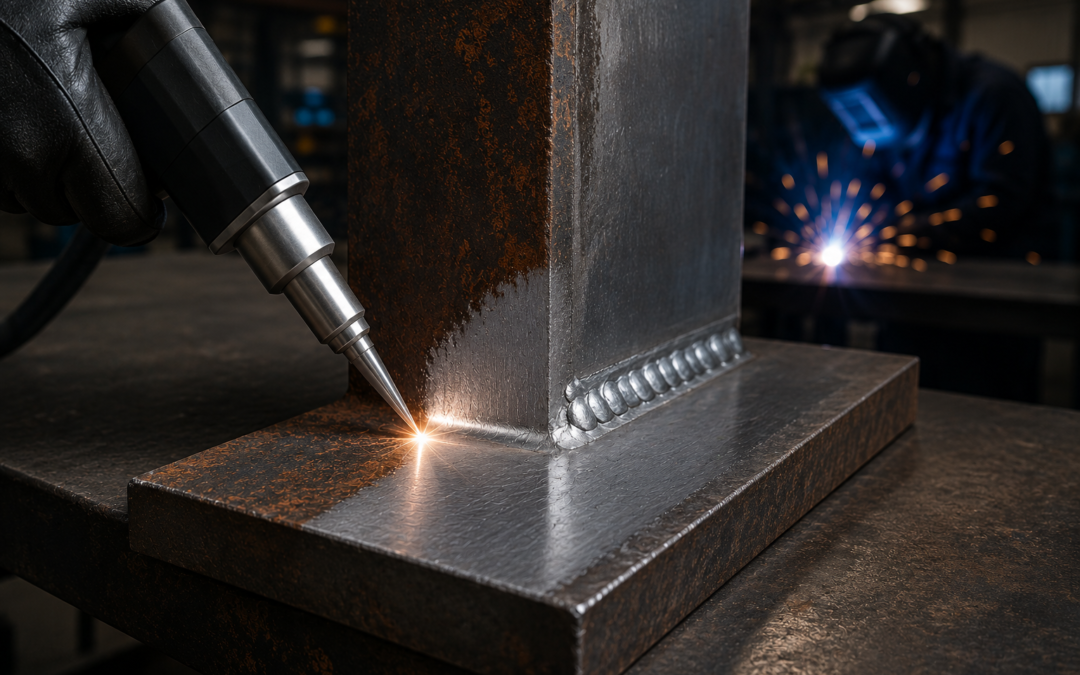
Laser cleaning uses concentrated pulses of light energy to remove contamination from a metal surface.
The contaminants absorb the laser energy more efficiently than the underlying metal. As a result, rust, paint, oxidation, and other unwanted layers are rapidly heated and removed, while the base material remains largely unaffected.
This process is known as laser ablation.
Because the laser can be carefully controlled, it removes only the unwanted layer while preserving the integrity of the metal beneath.
Benefits of Laser Cleaning for Weld Preparation
Precise Surface Cleaning
Laser cleaning targets contamination with exceptional accuracy. Operators can clean only the areas that require preparation without affecting surrounding components.
No Abrasive Damage
Unlike grinding or blasting, laser cleaning does not physically erode the metal surface. This helps maintain original dimensions and tolerances.
Consistent Weld Quality
Removing contaminants improves weld penetration and reduces the likelihood of defects such as porosity, inclusions, and weak joints.
Reduced Consumables
Laser cleaning does not require blasting media, chemicals, or abrasive discs, helping reduce waste and ongoing material costs.
Environmentally Friendly
The process generates minimal secondary waste compared to many traditional cleaning methods and eliminates the need for harsh chemical cleaners.
Industries Using Laser Cleaning Before Welding
Laser cleaning is increasingly used across a wide range of industries, including:
• Manufacturing
• Automotive restoration
• Aerospace engineering
• Shipbuilding
• Heavy equipment maintenance
• Structural steel fabrication
• Industrial production facilities
Many businesses are adopting laser cleaning as part of their welding workflow to improve efficiency and achieve more reliable results.
Is Laser Cleaning Better Than Grinding?
Grinding remains useful in certain applications, especially where heavy material removal is required. However, when the goal is simply to remove contamination while preserving the base material, laser cleaning offers significant advantages.
The process is cleaner, more precise, and reduces the risk of altering the metal surface before welding.
Conclusion
Proper surface preparation is one of the most important steps in achieving strong, reliable welds. Laser cleaning provides an advanced solution for removing rust, oxidation, paint, and contaminants without damaging the underlying metal.
As industries continue to seek cleaner, safer, and more efficient maintenance methods, laser cleaning is becoming an increasingly valuable tool for weld preparation and industrial manufacturing.